China Top 10 FBE Coating LSAW Steel Pipe Factories?
China’s FBE-coated LSAW steel pipe sector serves demanding pipeline projects, where coating quality and weld integrity matter as much as price. The World Steel Association reported 1,888.2 million tonnes of crude steel production worldwide in 2023, a useful measure of the industry’s scale, though not a direct measure of pipe output. Its World Steel in Figures 2024 report provides that context. For buyers, the more practical questions are specific: Can a factory document steel grades, pipe dimensions, coating thickness, and inspection results?
FBE, or fusion-bonded epoxy, is commonly used to protect buried steel pipe from corrosion. Mars G. Fontana, a leading corrosion engineer, wrote, “Corrosion is the destructive attack of a material by reaction with its environment” in Corrosion Engineering. That principle helps explain why surface preparation and coating inspection deserve close attention. Details matter. This guide compares China’s leading FBE coating LSAW steel pipe factory candidates by manufacturing capability, quality documentation, testing practices, and project experience. A top-ten list is not a certification, and rankings can change as evidence changes. Buyers should verify current records directly, including coating standards, sample inspection reports, and references for comparable projects. The comparison is a starting point, not a substitute for technical review.
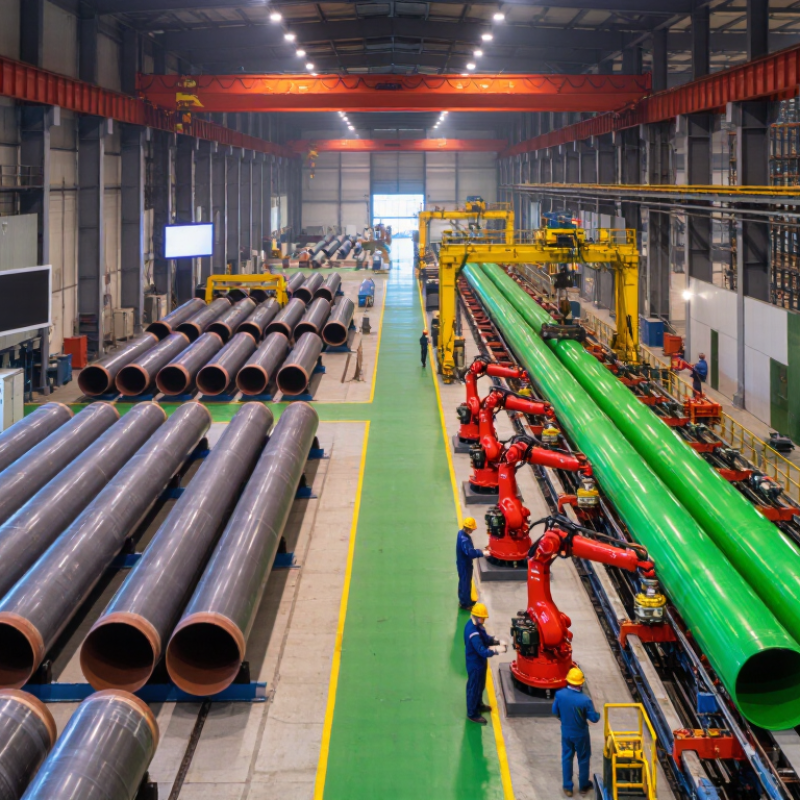
What FBE-Coated LSAW Steel Pipes Are and How They Are Used
Fusion-bonded epoxy, or FBE, is a factory-applied protective coating for LSAW steel pipes. LSAW means longitudinal submerged arc welded, with a straight weld seam along the pipe. During production, steel is blasted, heated, and covered with charged epoxy powder. The powder melts and forms a dense, strongly bonded layer. It is not ordinary paint.
FBE-coated LSAW pipes are widely used for buried oil, gas, water, and industrial pipelines. They resist soil moisture, salts, abrasion, and many chemicals. Large diameters also make them practical for long-distance transport. In real projects, engineers check coating thickness, surface cleanliness, holiday defects, adhesion, and weld-seam condition. A damaged coating can expose steel quickly. Small flaws matter.
Factory quality depends on more than modern equipment. Skilled operators must control blasting pressure, steel temperature, powder storage, and curing time. Traceable inspection records add confidence. Field handling still deserves attention; lifting chains, sharp supports, and rough backfilling can damage excellent factory work. That assumption is too simple. FBE also has limits in high-temperature service and severe mechanical conditions, so the coating system must match the environment. Buyers should review test reports, pipe dimensions, welding procedures, and repair methods before selecting a Chinese manufacturer. Experienced inspection helps, but it never replaces clear specifications.
FBE-Coated LSAW Steel Pipes: Coating Thickness Reference
Fusion-bonded epoxy (FBE) is a thermoset powder coating applied to heated steel pipe. It forms a continuous barrier against moisture and corrosion, making FBE-coated LSAW pipes suitable for buried or submerged water transmission, oil and gas pipelines, and other infrastructure applications. The values below show common dry-film thickness reference points; the final requirement is determined by the project specification and applicable standard.
Profiles of Ten Chinese FBE-Coated LSAW Pipe Factories
China’s FBE-coated LSAW pipe sector includes factories with different strengths. Factory One focuses on large-diameter transmission pipe and automated submerged arc welding. Factory Two serves water projects, using controlled blast cleaning before fusion-bonded epoxy application. Factory Three emphasizes coating consistency, with online thickness checks and batch records.
Factory Four combines pipe forming, welding, and coating under one production system. Its inspection team commonly checks weld appearance, dimensional tolerance, adhesion, and holiday detection. Factory Five handles heavy-wall pipe for demanding construction sites. Factory Six offers flexible lengths and coating thicknesses, which can help reduce field joints. Factory Seven is better suited to medium-volume orders and custom specifications. Factory Eight highlights laboratory testing, including impact resistance and cathodic disbondment evaluation.
Factory Nine focuses on export preparation, with wooden supports, end protection, and document control. Factory Ten concentrates on quality traceability, linking steel plates, welding consumables, and coating batches to inspection reports. Details matter. A capable factory should explain surface preparation, curing temperature, coating repair, and testing standards clearly.
From practical sourcing experience, a factory profile is only a starting point. Buyers should review recent inspection records, sample coating results, production photographs, and independent testing options. Some suppliers describe equipment more confidently than their records justify. That gap deserves attention. Factory size also does not guarantee stable coating quality. Weather, storage conditions, operator training, and pipe handling can affect performance. A careful assessment should compare technical evidence, communication speed, and corrective-action discipline before any purchase decision.
China Top 10 FBE Coating LSAW Steel Pipe Factories? – Profiles of Ten Chinese FBE-Coated LSAW Pipe Factories
Anonymous supplier-screening reference: the entries below summarize verifiable technical criteria, not ten independently verified factory rankings or company-specific production claims.
| No. | Profile Dimension | Factual Technical Reference | Evidence to Request from a Factory |
| 01 | LSAW manufacturing route | LSAW pipe has a longitudinal submerged-arc-welded seam. UOE and JCOE are established forming routes used in LSAW pipe production. | Production-route description, process flow, and records identifying the forming and welding route used for the ordered pipe. |
| 02 | Line-pipe specification | API Specification 5L covers steel line pipe. Applicable grade, product specification level, dimensions, and tests depend on the purchase specification. | Current conformity documents and the order-specific inspection and test plan; confirm the exact edition and requirements in the contract. |
| 03 | External FBE coating standard | ISO 21809-2 specifies requirements for single-layer fusion-bonded epoxy external coatings for buried or submerged pipeline transportation systems. | Coating procedure, applicable standard and edition, coating-system qualification records, and batch-specific inspection results. |
| 04 | Water-pipeline coating reference | AWWA C213 addresses fusion-bonded epoxy coating for the interior and exterior of steel water pipelines. Applicability depends on the service and project specification. | Written confirmation that the proposed coating system and application meet the project’s stated water-service requirements. |
| 05 | Surface preparation | Abrasive blast cleaning is commonly specified before FBE application. ISO 8501-1 includes Sa 2½ as a preparation grade; the contract determines the required grade. | Surface-preparation procedure, inspection records, and evidence that cleanliness is checked before coating application. |
| 06 | Coating application and cure | FBE is a thermosetting powder coating commonly applied to prepared, heated steel and then cured. Process parameters are coating-system and project specific. | Approved application procedure, recorded process parameters, and traceable coating-material batch information. |
| 07 | Coating thickness | There is no single universal FBE thickness suitable for every pipeline project; the governing standard, coating system, and purchase specification set the acceptance requirements. | Specified thickness range, calibrated-gauge records, measurement locations, and lot-level results. |
| 08 | Coating inspection | Holiday detection and other coating tests may be required. Test methods, acceptance criteria, and inspection frequency must be defined by the applicable specification. | Inspection and test plan, equipment calibration records, acceptance criteria, and signed results for the production lot. |
| 09 | Pipe testing and traceability | Line-pipe testing and marking requirements are governed by the applicable product specification and purchase order; requirements should be checked for the ordered grade and size. | Pipe-by-pipe or lot traceability linking material identification, manufacturing records, test results, and coating records. |
| 10 | Project fit and delivery scope | Permitted pipe dimensions, tolerances, coating scope, end protection, and delivery conditions are project-specific rather than universal factory attributes. | A written, order-specific compliance matrix covering dimensions, coating, inspection, marking, packaging, and shipping requirements. |
Verification note: Factory capacity, certifications, project references, and production equipment are not inferred here. Verify these claims directly against current, independently checkable records before shortlisting suppliers.
Manufacturing Processes, Standards, and Quality Inspections
LSAW steel pipe quality starts with plate inspection, edge preparation, forming, and submerged arc welding. Operators check weld alignment and use ultrasonic or radiographic testing to find defects. Pipe dimensions and mechanical properties are verified against the purchase specification, often including API 5L requirements. FBE coating follows a separate process. The pipe surface is cleaned, usually to a specified blast-cleaning grade, then checked for dust, soluble salts, and surface profile. Small defects matter. Even a sound weld can be undermined by poor surface preparation.
The pipe is heated to a controlled temperature before electrostatic FBE powder is applied and cured. Temperature records, coating thickness measurements, and holiday testing help identify thin areas or pinholes. Inspection criteria should follow the project specification and applicable coating standards, such as ISO 21809-2 where specified. Measure, then record. Adhesion checks and visual examination add useful evidence, though test frequency varies by project. A clean report is helpful, but it cannot prevent damage during lifting or transport. This step is easy to underestimate. Factories should protect coated pipe with suitable supports and inspect it again before dispatch; a small handling mark may need repair.
How Buyers Can Compare Suppliers and Verify Factory Credentials
When comparing FBE-coated LSAW steel pipe factories, look beyond production capacity and export photos. Ask for the actual manufacturing address, business registration details, and a live video walkthrough. Check that the workshop shown can produce the pipe dimensions and coating thickness listed in the quotation. A large yard can look convincing. It does not prove that every process happens there.
Review recent inspection records for steel grade, weld testing, surface preparation, and coating thickness. Ask how the factory measures surface cleanliness and detects coating holidays. Request traceable sample documents linking a pipe number to its test results. Where possible, compare those records with an independent inspection report. One document may be outdated, so check dates and product specifications carefully. I would also ask how rejected pipes are identified and stored; suppliers do not always explain this clearly.
Tips: Confirm the production site before paying a deposit. Match the quotation, drawings, and certificates line by line. Ask for recent, project-relevant records rather than generic samples. If answers remain vague, pause and verify the details independently.